How to Choose an Engagement Ring (And Why Lab Diamonds Are the New Standard)
Buying an engagement ring has a funny way of making otherwise normal people start acting like they’re studying for an exam. You begin by thinking you just need a ring, and twenty minutes later you’re comparing pavilion depth, debating platinum versus white gold, and wondering whether “eye-clean” is a real term or something the jewelry world made up to mess with you.
The good news is that this does not need to be complicated. You do not need to become a gemologist in a weekend. You just need a simple order of operations, a decent sense of what your partner will actually want to wear every day, and a clear understanding of what matters most once the diamond itself enters the conversation. And in 2026, that last part increasingly means understanding why lab-grown diamonds have moved from alternative option to default choice for a lot of couples.
This guide covers both halves: how to choose an engagement ring that makes sense for your partner’s actual life, and why lab-grown diamonds are quickly becoming the new standard, including the tradeoffs nobody talks about.
Part One: Choosing an Engagement Ring
Start with Your Partner, Not the Diamond
The easiest way to make ring shopping harder than it needs to be is to begin with carat size. The better move is to begin with the person who’s going to wear it. Do they wear simple jewelry or things with more detail? Yellow gold or white metals? Clean, modern clothes or more vintage-looking pieces? A ring is daily-wear jewelry, which means it has to make sense on an ordinary Tuesday, not just in a velvet box.
When we sat down with Sarah, one of the diamond experts at Ada Diamonds in New York, her starting point was refreshingly non-technical. She said to think about your partner’s vibe and pick something that feels like them. If they lean simple and classic, consider a solitaire. If they’re bolder and like a little flash, look at accent stones. Her take was that you’ll know when something feels right for them, and that gut instinct is more reliable than any spec sheet.
That tracks. About 78% of couples now collaborate on ring selection anyway, so the “total surprise with the perfect ring” expectation may itself be outdated. But if you are doing it solo, pay attention to the jewelry she already wears every day. Metal color, stone size, minimalist versus ornate. Those are better signals than any Pinterest board.
The 4Cs: What Actually Matters
The Gemological Institute of America created the 4Cs (cut, color, clarity, and carat) as a standardized way to evaluate diamond quality. You have probably heard of them. But what most people do not realize is that they are not equally important. Not even close.
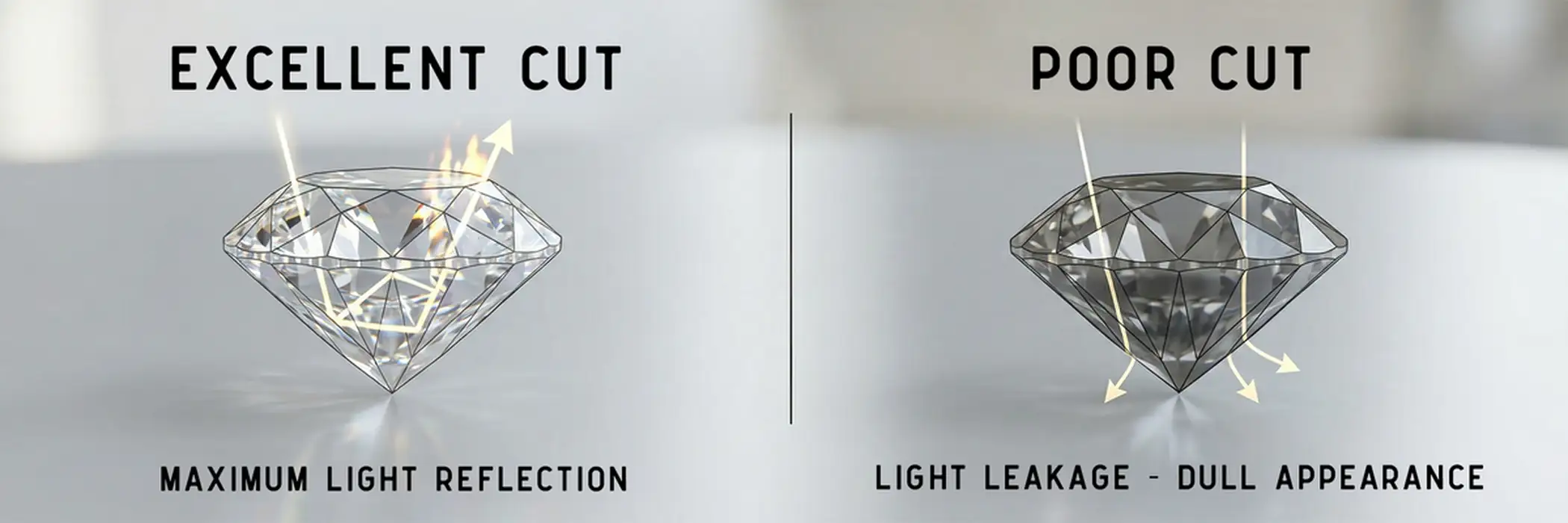
Cut is the whole game. Cut does not mean shape (round, oval, emerald: that’s shape). Cut refers to how well the diamond’s facets have been angled and polished to interact with light. A well-cut diamond creates three things: brilliance (the white light bouncing back at you), fire (those little rainbow flashes), and scintillation (the sparkle pattern when the diamond moves). GIA is unusually direct about this, noting that a diamond’s beauty depends more on cut quality than anything else.
Here is the thing that matters practically: a poorly cut 2-carat diamond will look duller than a well-cut 1-carat diamond. The bigger stone loses because light leaks out the bottom or sides instead of reflecting back to your eye. Every expert says to never compromise on cut. Always aim for Excellent or Ideal.
Color grades the absence of color on a D-to-Z scale, where D is perfectly colorless and Z is noticeably yellow. The honest truth is that most people cannot tell the difference between a D and a G or H once the diamond is set in a ring. The sweet spot is G or H: they look white to the naked eye and save 20-30% compared to the premium colorless grades. GIA makes a useful point here too: diamonds reflect their surroundings, including the prongs and band. So the metal you choose actually affects how the diamond’s color reads. If you are going with yellow or rose gold, you can drop even lower (I or J) because the metal’s warmth masks any slight warmth in the stone. Paying for a D-color diamond in a yellow gold ring is like putting premium fuel in a lawnmower.
Clarity measures inclusions, the tiny imperfections inside a diamond that are graded under 10x magnification. The scale runs from Flawless down to Included. Sarah at Ada put it simply: once you are at VS2 and above, you are not going to see a difference in sparkle with the naked eye. The inclusions are so small they do not affect how the diamond performs. The goal is not to buy a statistically flawless diamond. It is to find one that is “eye-clean,” meaning no visible inclusions without a loupe. You are not buying a microscope. VS2 to SI1 is the value sweet spot.
Carat is weight, not size. One carat equals 200 milligrams. This is the one everybody focuses on, but it is actually the least important of the four when it comes to how the ring looks. Two diamonds can weigh the same and appear totally different sizes depending on their cut and shape. An elongated oval spreads its weight across a larger surface area and looks bigger than a round diamond of the same carat weight.
One useful trick: diamond prices jump dramatically at round numbers. A 1.00-carat diamond can cost up to 20% more than a 0.95-carat diamond with the same grades, and the size difference is invisible on a finger. Buying just shy of those magic numbers (0.90 instead of 1.00, or 1.40 instead of 1.50) is one of those rare shopping hacks that is actually useful instead of annoying.
The priority order: Cut first, then Color, then Clarity, then Carat. If you remember nothing else from this section, remember that.
Diamond Shapes
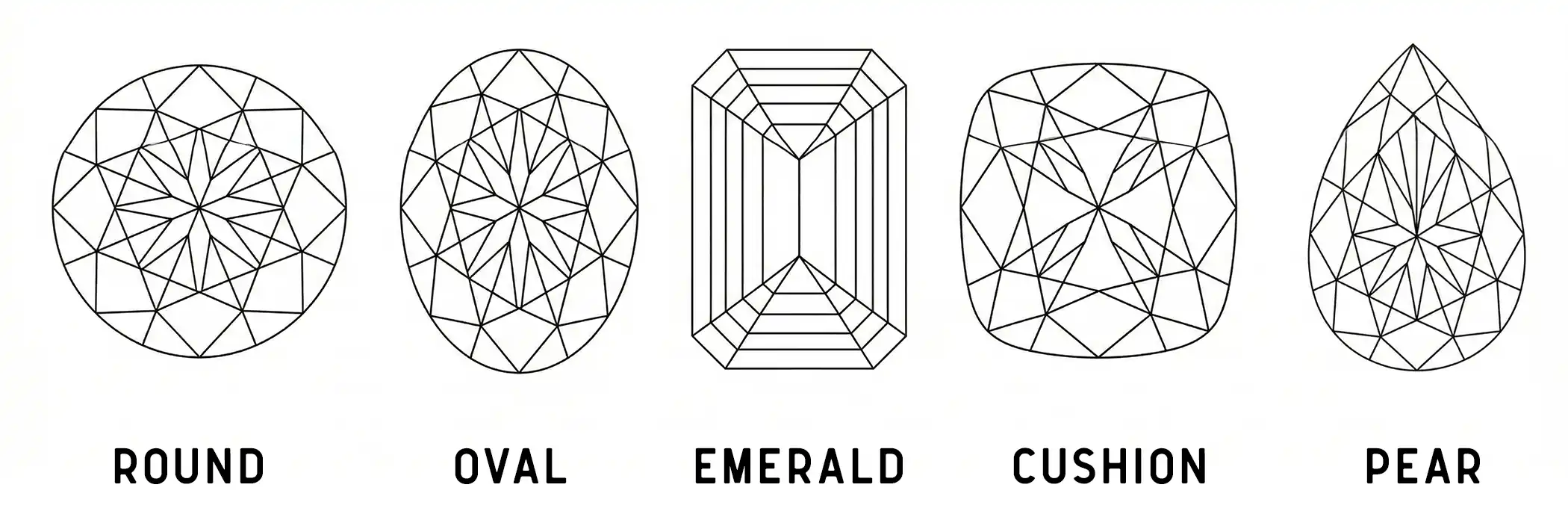
Shape is one of the biggest drivers of how a ring feels, and it matters more than first-time buyers expect. The best way to decide is to see different shapes on your partner’s actual hand (or at least a hand with similar proportions). Photos do not tell the whole story because shapes interact differently with different finger lengths and widths.
A few things worth knowing. Round brilliant is classic for a reason: 57 or 58 facets engineered for maximum sparkle, and it is the only shape that gets a formal cut grade from GIA. Oval is having a massive moment and creates an elongating effect on the finger. Emerald cut has that gorgeous “hall of mirrors” look, but the open table acts like a window into the stone, so you will want higher clarity and color grades. Cushion cuts have a romantic, vintage quality. And if you are going with anything that tapers to a point (pear, marquise), make sure the setting has V-prongs to protect those delicate tips.
One thing to watch for with ovals specifically: the “bow-tie effect.” Most ovals have some degree of a dark shadow stretching across the center width of the stone, caused by how the elongated facets interact with light. A little bow-tie is normal, but a heavy one makes the diamond look dark in the middle. GIA notes that a well-cut oval minimizes it and keeps light moving evenly. This is one of those things that is hard to catch in photos and is best evaluated in person.
Settings
The setting does two things: it determines the visual style of the ring, and it affects how the ring handles daily life. Some settings are gorgeous but high-maintenance. Others are bombproof but more understated. The trick is matching the setting to both the aesthetic and the lifestyle.
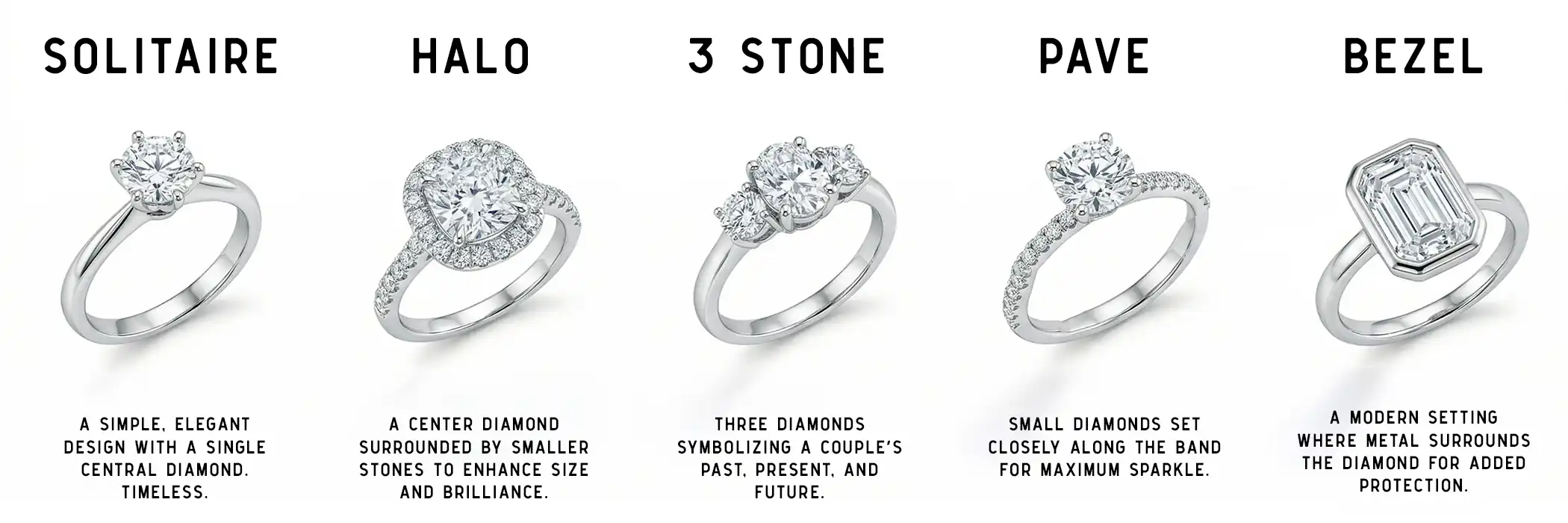
A solitaire is the “can’t go wrong” option. One center stone, clean lines, maximum focus on the diamond. There is a reason solitaires have been the default for decades: they are timeless, they are elegant, and they pair with basically any wedding band. If your partner’s style leans minimal, this is the safest bet.
A halo setting surrounds the center stone with a ring of smaller diamonds, which creates the illusion that the center stone is about a quarter- to half-carat larger than it actually is. More visual impact from a smaller center stone, though the look can trend ornate and it requires more maintenance over time.
Three-stone rings carry a nice symbolic meaning (past, present, future) and create visual weight without the busyness of a full halo. Pavé settings line the band with tiny diamonds for continuous sparkle, though if one of those small stones falls out it can be more involved to replace than you would expect.
Bezel settings are surging in popularity right now, and for good reason. A bezel wraps a solid rim of metal around the entire perimeter of the diamond, giving it a sleek, modern look and making it the most secure setting you can get. If your partner is active, works with her hands, or just does not want to worry about snagging a prong on a sweater, bezel is worth a serious look.
Metals
Metal changes more than color. It changes maintenance, durability, and even the way a diamond reads visually. This is not a small decision when you realize she is wearing it every day for the rest of her life.
Platinum is the “buy once, cry once” choice. It is 90-95% pure, naturally white (so it never needs re-plating), hypoallergenic, and provides the strongest prong security. When platinum scratches, the metal displaces rather than flakes off, eventually developing a matte patina that some people love. The tradeoff is cost (settings typically run $1,500-$3,000+) and weight. It is the heaviest option.
White gold gives you a similar look for less money, but there is a catch: gold is naturally yellow. White gold gets its bright appearance from an alloy mix and a rhodium plating on top. That plating wears off over time, usually every 12 to 18 months, revealing a warm yellowish undertone beneath. So white gold rings need periodic maintenance to keep that icy look. White gold alloys also sometimes contain nickel, which can be an issue for metal allergies.
Yellow gold is the classic choice and the easiest to work with for repairs and resizing. It is experiencing a genuine resurgence after years of white metal dominance. Fun bonus: yellow and rose gold settings can actually make a near-colorless diamond (I-J range) appear whiter by contrast with the warm metal, which means you can save on color grade without any visible downside.
Rose gold has a warm, romantic look with good durability (thanks to copper content), but it is not hypoallergenic.
One practical tip: match your engagement ring metal to whatever you are planning for the wedding band. If you pair two different metals with different hardness levels, the harder one will gradually scratch the softer one over time.
The 14k versus 18k question is worth considering too. 14k gold (58.3% pure gold) is harder and more scratch-resistant, making it the better choice for daily wear. 18k gold (75% pure gold) has a richer, more saturated color but is slightly softer. Most engagement rings lean toward 14k for durability, and honestly, the color difference between the two is subtle.
Sizing, Budget, and Timing
Sizing is the unglamorous part of engagement ring shopping, which is exactly why people mess it up. The average women’s ring size is US 6 to 6.5, but you need the actual number. If you are doing this as a surprise, the best methods are borrowing a ring she wears on the correct finger and taking it to a jeweler, tracing the inside diameter on paper, or pressing the ring into a bar of soap for an impression.
Common mistakes: measuring when hands are cold (fingers shrink), measuring the wrong finger or hand, and forgetting that wider bands fit more snugly than thin ones. If you are going with a thicker band, you may need to size up by a quarter to half size. Most rings can be resized 1-2 sizes ($50-$150 for gold, $150-$300 for platinum), so when in doubt, size up. It is easier to make smaller than larger. Some styles cannot be resized easily, including eternity bands, pavé or channel-set bands, and rings with intricate engraving. If you are choosing one of those, get the size right the first time.
Budget. You have probably heard the “three months’ salary” rule. This one deserves to die already. It was invented by De Beers in the 1930s as an advertising campaign. It started as one month’s salary, escalated to two after World War II, then three by the 1980s. It was never a cultural tradition. It was a marketing slogan, and a brilliant one, because it is still rattling around people’s heads almost a century later.
About 61% of Americans now say that guideline is not feasible. The average engagement ring spend sits around $5,000-$5,500. The modern version: spend what you can comfortably afford without compromising financial goals. You are (hopefully) about to plan a wedding, buy or rent a home, maybe start a family. A good ring should feel meaningful, not financially stupid.
Timing. If the proposal date matters, do not treat ring production like ordering a phone charger. Custom work, stone sourcing, setting, and possible resizing all take time. Give yourself a buffer of several weeks, minimum. The romantic version of this story is a perfect surprise. The practical version is giving yourself enough room so the surprise is not “good news, it’ll be ready next week.”
And this is where lab-grown diamonds enter the conversation in a big way. They let you either get significantly more ring for the same budget, or spend significantly less for the same visual result.
Part Two: Lab-Grown vs. Mined Diamonds
They Are the Same Thing
The first thing to clear up is the most important one: a lab-grown diamond is a real diamond. It is not cubic zirconia. It is not moissanite. It is not a “simulated” anything.
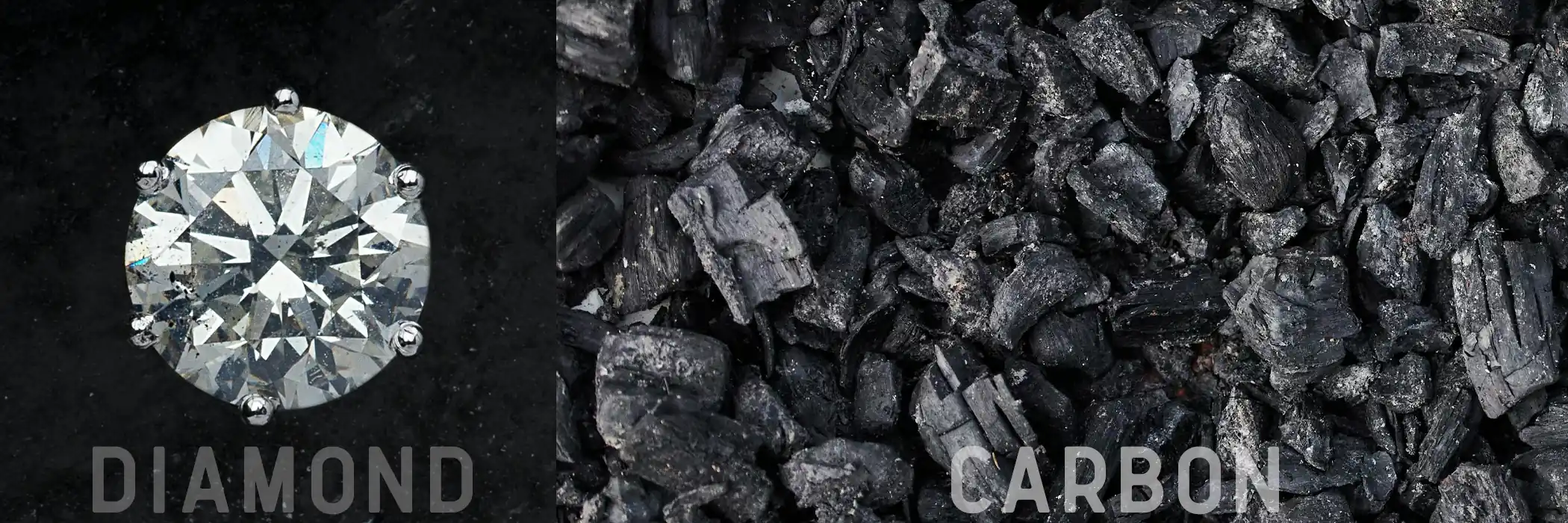
Lab-grown diamonds have the exact same chemical composition (pure crystallized carbon), the same crystal structure, the same hardness (a perfect 10 on the Mohs scale, shown below), and the same optical properties as mined diamonds.
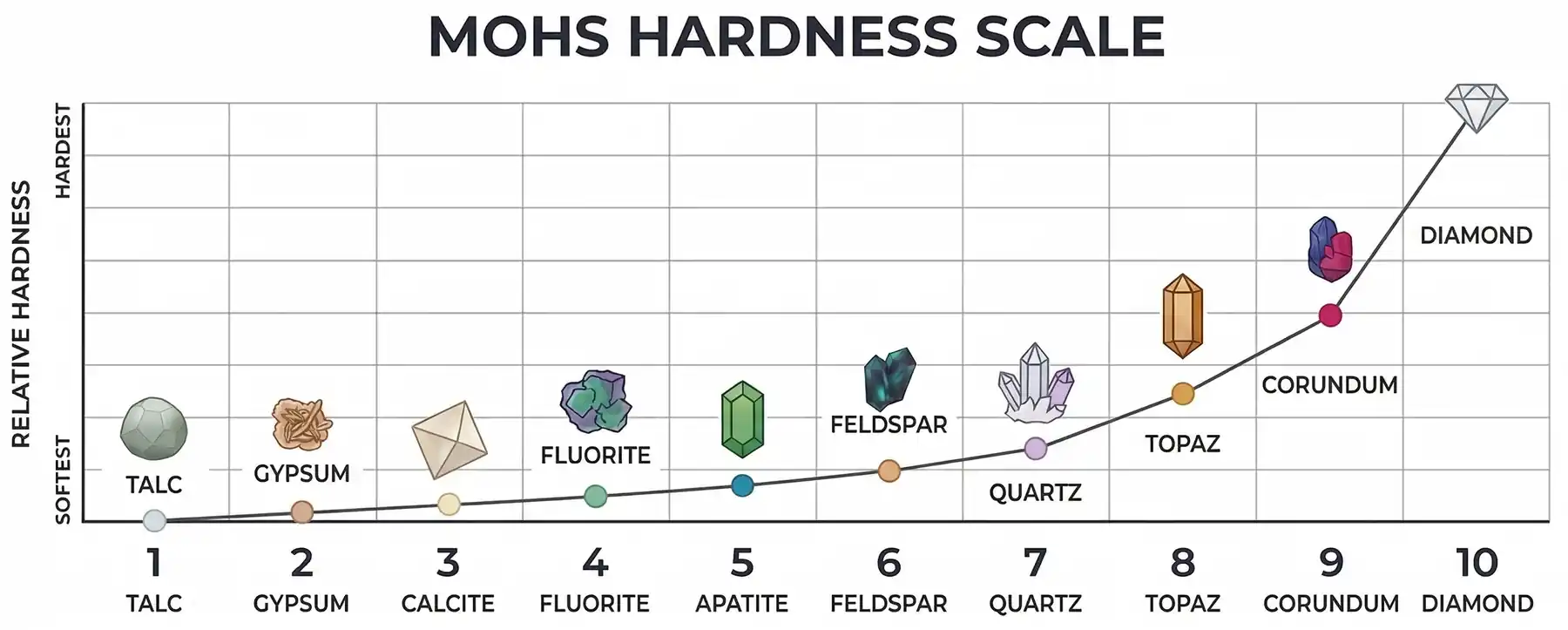 The FTC formally recognized lab-grown diamonds as real diamonds in 2018. GIA confirms that traditional gemological observation and standard diamond detectors cannot tell them apart. Only specialized spectrographic equipment can identify growth-method markers.
So the actual difference is origin. Mined diamonds formed deep in the Earth over one to three billion years. Lab-grown diamonds are created through HPHT (High Pressure High Temperature) or CVD (Chemical Vapor Deposition) processes in controlled environments over a period of weeks. HPHT replicates the Earth’s conditions with extreme pressure and heat. CVD uses plasma to break down a hydrocarbon gas, depositing carbon atoms layer by layer onto a diamond seed. Both methods produce gem-quality diamonds that are indistinguishable from mined stones.
There is actually a compelling purity argument here that most people do not know about. Over 98% of mined diamonds are classified as “Type I,” meaning they contain trace nitrogen trapped in their carbon lattice (that nitrogen is what causes yellow or brown tints). Diamonds completely free of nitrogen are called “Type IIa,” and in nature, they are extremely rare: only about 1-2% of all mined diamonds qualify. Famous stones like the Koh-i-Noor are Type IIa. But because the lab environment is controlled to eliminate atmospheric contaminants, the vast majority of lab-grown diamonds (especially CVD) achieve Type IIa status. You are routinely getting a level of chemical purity that costs a fortune in the mined world.
The Price Difference Is Hard to Ignore
The strongest argument for lab-grown is not that mined diamonds are fake luxury or that everyone should feel guilty buying one. It is that for most modern buyers, lab-grown now delivers the better mix of beauty, flexibility, and sanity.
In 2015, lab-grown diamonds offered maybe a 30% discount over mined equivalents. Today, that gap has widened to 60-90%. A 1-carat lab-grown diamond with excellent grades runs roughly $800-$1,500 versus $4,000-$6,000 for a comparable mined stone. At 2 carats, the math gets even more dramatic.
What this has done to buying behavior is telling. The average lab-grown engagement ring center diamond has gone from 1.31 carats to about 2.45 carats since 2019, an 87% jump. People are not just pocketing the savings. They are using the budget room to go bigger, go higher quality, invest in a more intricate setting, or - the smartest move - just keep the savings and put it toward the wedding, a house, or literally anything else.
That is the real shift. Lab-grown lets people prioritize cut, setting, and shape without having to make miserable tradeoffs. It lets someone choose the ring they actually want instead of the ring that technically fits the old natural-diamond budget. And once that starts happening at scale, “alternative” stops being the right word.
The Ethical and Environmental Case Is Strong, But Not Automatic
This is where the conversation needs to stay honest. Lab-grown diamonds avoid the mining process, and that alone removes a lot of the baggage people rightly care about.
The ethics case is real. The mined diamond industry has a documented history of conflict financing. Rebel groups in Angola, Sierra Leone, and the DRC used diamond revenues to fund civil wars that killed millions. The Kimberley Process was established in 2003 to curb conflict diamonds and has reduced them from roughly 15% to about 1% of global supply. But Global Witness, one of the organizations that helped create the scheme, abandoned it in 2011 because they considered it unable to address the broader range of human-rights risks in the diamond trade. Lab-grown diamonds bypass these supply chain concerns entirely because they are produced in controlled facilities with shorter, more traceable chains of custody.
The sustainability case is nuanced. Lab diamonds win clearly on land disruption (no massive mining operations, no ecosystem destruction), water usage (mining can require up to 3,900 liters per carat), and mineral waste. But energy consumption is where it gets complicated. Lab diamond production is energy-intensive, and a lot of production happens in China and India where coal is still a major power source. When labs run on renewables, the carbon footprint drops dramatically. When they run on coal, it can actually rival or exceed mining emissions. The AP reported in 2024 that many manufacturers market themselves as sustainable without publishing credible impact reports, and the FTC warned eight lab diamond companies in 2019 about unqualified “eco-friendly” claims.
So: lab-grown is not a free pass to call something green. The better version of the argument is that lab-grown can be the more responsible choice, especially when the seller is transparent about energy sources and supply chain practices. But you still have to ask questions.
The Quality Pitfall Nobody Warns You About
This is something that most “lab diamonds are amazing!” articles skip entirely.
Not all lab diamonds are created equal. As demand has exploded, the market has been flooded with cheaply produced stones from growers prioritizing speed and volume over quality. The industry has shifted from wanting to grow really nice lab diamonds to wanting to grow as many as possible, as cheaply as possible, and that shows up in the final product.
The problems do not show up on a standard grading report. A diamond can have a G color grade and VS1 clarity on paper and still look underwhelming in person because of issues unique to the growth process. Gray or brown tints that make the stone look muddy. Phosphorescence, a ghostly glow after UV exposure caused by boron contamination. Internal striations from rushed CVD growth that leave the diamond looking hazy or lifeless. This guide from Ada on blue nuance and phosphorescence is worth reading regardless of where you end up buying.
Something else worth knowing if you are shopping online: most e-commerce sites pull from the same direct feeds from growers, which means you can see the exact same diamond listed on five different websites. That sounds convenient, but it means the stone might already be sold, and nobody at those retailers has physically inspected it. They are listing what the grower says is available, not what they have actually verified.
Whatever retailer you choose, ask what they screen for beyond the certificate. Do they physically inspect stones before selling them? Do they check for tints, phosphorescence, and light leakage? A grading report tells you a diamond has the ability to be beautiful. It does not tell you that it actually is.
The Honest Downside: Resale
The cleanest case for mined diamonds today is resale and long-term scarcity. Lab-grown diamonds currently have minimal resale value, roughly 10-15% of what you paid. Mined diamonds retain more, typically 40-60% on the secondary market. Lab-grown prices have also dropped steeply as production has scaled, and analysts warn that trend will continue.
That is a real tradeoff, and it should be said plainly. If someone wants a stone partly because they care about rarity and future value, mined diamonds still have the better story.
But here is the math that puts it in perspective: losing 100% of a $1,200 lab diamond costs you $1,200. Losing 50% of a $5,000 mined diamond costs you $2,500. The “better resale” option actually loses you more money in absolute terms. And most people are not buying an engagement ring as an asset class. They are buying a piece of jewelry that marks a commitment. For that buyer, getting a better-looking ring for less money is not a compromise. It is just common sense.
Why Lab Is Becoming the Standard
Lab-grown diamonds went from about 5% of US engagement ring center stones in 2019 to roughly 50% today. Two-thirds of Gen Z buyers choose lab-grown. Every major retailer has adopted them: Signet (Kay, Zales, James Allen, Blue Nile), Pandora, Brilliant Earth, Macy’s. Even De Beers, the company that literally built the mined diamond industry, launched a lab-grown line called Lightbox. When the incumbent starts selling the disruptor’s product, you know the market has shifted.
The reasons are practical, not ideological. Lab diamonds offer the same physical product at a fraction of the price, with fewer ethical concerns and generally lower environmental impact. For most people, that combination makes the decision pretty straightforward.
Mined diamonds still matter to people who value natural rarity, geological origin, and the symbolism of something that has been forming for a billion years, and those are legitimate preferences. A ring does not need to be optimized like a spreadsheet to be the right one. But as the default starting point for a first-time buyer, lab-grown makes a lot of sense.
Where We Went
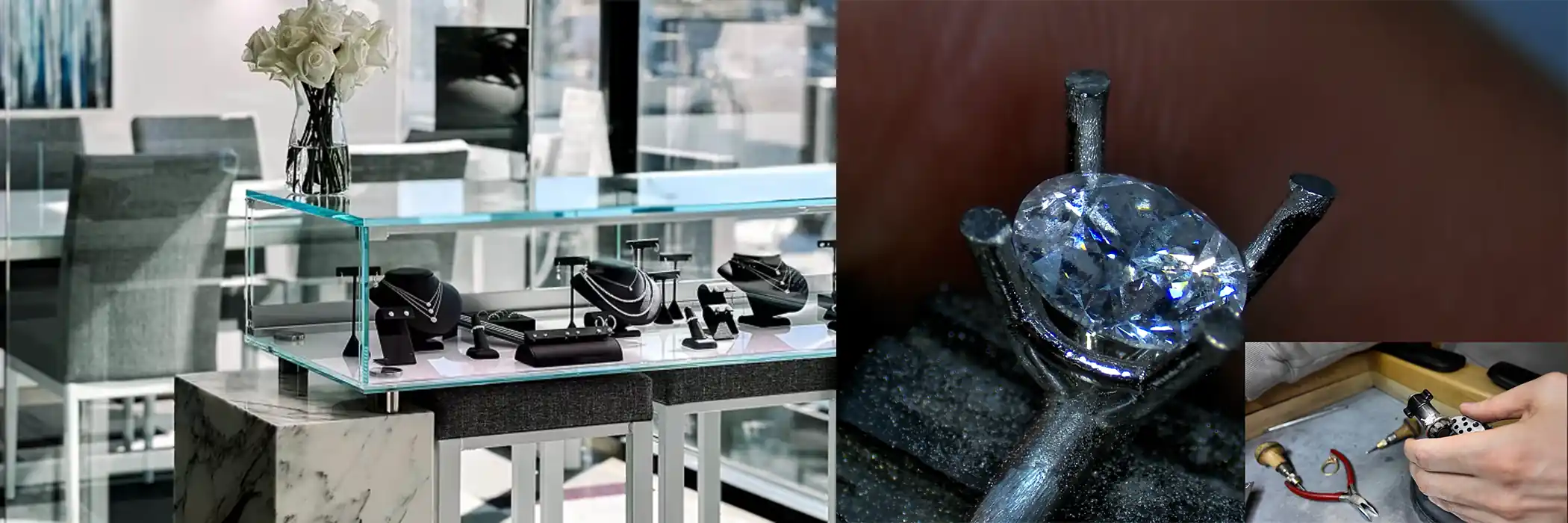
We ended up at Ada Diamonds in New York because we wanted someone to actually sit down with us and walk us through the process, not just browse listings online. Sarah, the expert we worked with, was knowledgeable and straightforward. No upselling, no pressure. She showed us good and bad lab diamonds side by side, explained what to look for beyond the grading report, and let us make our own call.
There are other good lab diamond retailers out there. But if you want the in-person experience and you are in New York, Ada is worth checking out.
The Engagement Ring Checklist
This is the “screenshot this and save it to your phone” section.
1. Start with your partner’s actual style, not trend photos. Look at the jewelry she wears every day. Metal color, scale, minimalist versus ornate.
2. Set a budget based on real life, not the salary myth. Factor in whether you are going lab-grown or mined, because that decision alone can shift your budget by 60-90%.
3. Choose a metal. Platinum for maximum durability and zero maintenance. White gold for a similar look at lower cost (but factor in re-plating every 12-18 months). Yellow or rose gold for warmth and lower upkeep. Match it to what she already wears.
4. Pick a setting based on lifestyle. Solitaire if she is classic and low-maintenance. Halo for maximum visual impact. Bezel for active lifestyles and maximum security. Pavé for continuous sparkle (but know it requires more care).
5. Choose a diamond shape. Try to see shapes on an actual hand. Round brilliant for maximum sparkle. Oval for an elongated, modern look (watch for the bow-tie effect). Emerald for old-Hollywood elegance (go higher on clarity and color). Elongated shapes appear larger per carat.
6. Prioritize cut above everything else. Excellent or Ideal cut grade, always.
7. Optimize the other Cs for value. G-H color for white metal settings (I-J for yellow/rose gold). VS2 to SI1 clarity (eye-clean is the goal). Buy shy of magic carat numbers (0.90 instead of 1.00 saves real money with no visible difference).
8. If going lab-grown, vet the seller. Ask what they screen for beyond the grading report. Look for in-person inspection, high-quality video in multiple lighting conditions, and transparent return policies. A GIA or IGI report does not capture growth-related issues like tints or phosphorescence.
9. Get the certification. Make sure the diamond (lab-grown or mined) comes with a grading report from a recognized lab (GIA, IGI, or GCAL). Read it or have someone explain it to you.
10. Nail the size. Borrow a ring she wears on the correct finger, trace it, or bring it to a jeweler. When in doubt, size up. Ask about the jeweler’s resizing policy before you buy.
11. Give yourself time. Custom work, stone selection, setting, and resizing do not happen overnight. Build in a buffer of several weeks.
12. Think about the wedding band. Make sure the engagement ring and wedding band will sit flush together and ideally use the same metal to avoid scratching.
13. Insure the ring. This sounds boring and it is. Do it anyway.
Lab-Grown vs. Mined Diamonds: The Comparison
| Lab-Grown | Mined | |
|---|---|---|
| What it is | A diamond grown in a controlled lab environment over weeks using HPHT or CVD methods. Chemically, physically, and optically identical to mined. | A diamond formed deep in the Earth over 1-3 billion years, extracted through mining operations. |
| Chemical composition | Pure crystallized carbon (typically Type IIa, the purest classification, free of nitrogen). | Pure crystallized carbon (overwhelmingly Type I, contains trace nitrogen; only 1-2% achieve Type IIa). |
| Hardness | 10/10 Mohs scale. | 10/10 Mohs scale. |
| Can you tell the difference? | Not with the naked eye or a standard jeweler’s loupe. Requires specialized spectrographic equipment. | Not with the naked eye or a standard jeweler’s loupe. Requires specialized spectrographic equipment. |
| Cost (1ct, G color, VS1 clarity) | Roughly $800-$1,500. | Roughly $4,000-$6,000+. |
| Quality risks | Rushed growth can cause gray/brown tints, phosphorescence, and internal striations not captured on grading reports. In-person vetting is important. | Cut quality is critical. A poor cut makes even a high-grade stone look dull. Sourcing transparency varies. |
| Environmental impact | Minimal land disruption and water usage. Carbon footprint varies significantly by energy source: low with renewables, potentially high with coal-powered grids. | Large-scale land excavation, high water usage (~3,900 liters/carat), ecosystem disruption, and ~125-160 kg CO₂/carat. |
| Ethical concerns | Shorter, more traceable supply chains. Produced in controlled facilities. | Kimberley Process reduced conflict diamonds to ~1%, but the scheme has known limitations and enforcement gaps. |
| Resale value | Low, roughly 10-15% of purchase price. | Moderate, roughly 40-60% of purchase price. Neither is a reliable financial investment. |
| Best for | Buyers who want maximum beauty and quality per dollar, prefer modern sourcing, and are comfortable treating the ring as jewelry, not an investment. | Buyers who value natural rarity, geological origin, and the symbolism of a billion-year-old artifact. |
The Finished Ring
After we picked the setting and the diamond, we went behind the scenes at Ada and watched the ring being made, from the wax model to the casting to the final polish. When we came back a few weeks later to see the finished product, Sarah let us do the honors. It was better than expected. The renderings and CAD designs were helpful during the process, but they do not do justice to the real thing.
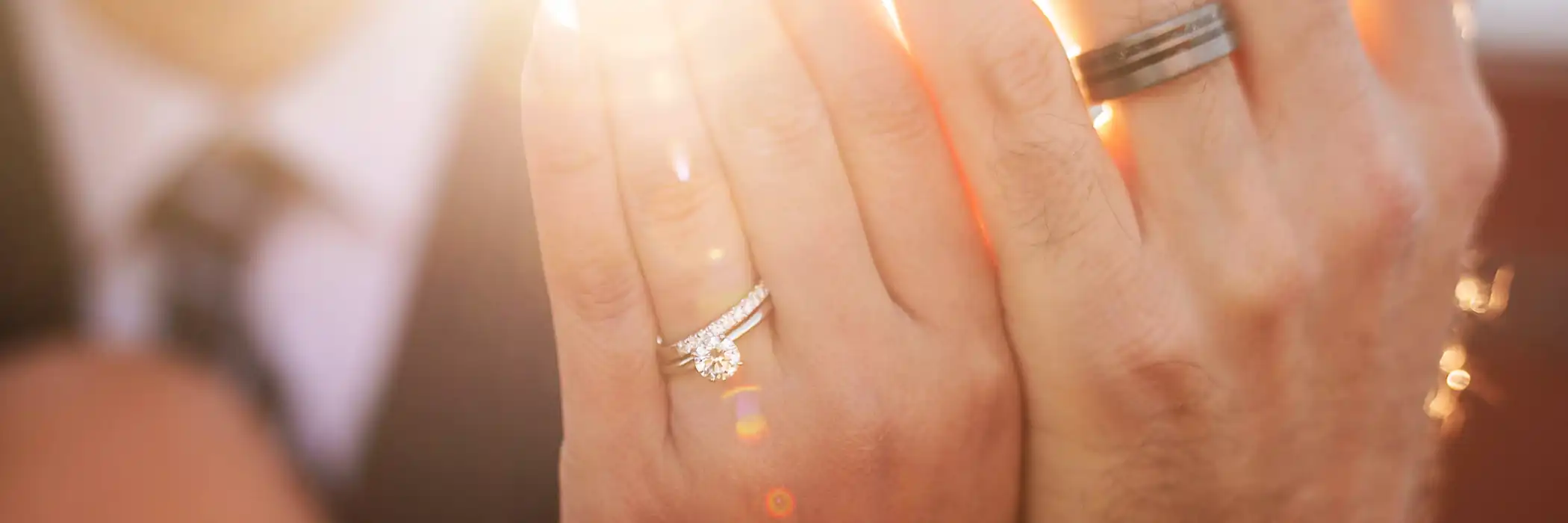
But the real test was not whether we liked it. The real test was whether she liked it. All that research, all those consultations, all the decisions about cut grades and metal types: they were all in service of one moment.
She said yes. And seeing that ring find its home made every second of the process worth it.
Watch the Full Video
Here is the complete video of our experience at Ada Diamonds, from the initial consultation with Sarah to the behind-the-scenes ring creation to the finished product reveal.
In the end, the best engagement ring is not the one that wins the internet for thirty seconds. It is the one that feels right on the hand, makes sense for the person wearing it, and does not leave you wondering whether you paid for romance or just better marketing.
If you are starting the engagement ring process and have questions, we would love to hear from you. And if you end up finding a great lab diamond on your own, let us know how it goes!
About the Author


Ray is the founder of Stray Monkey, and as a shameless plug he wants to remind you to check out the SetScribe sports card collection app.
Share This Article
Check These Out




Support A Good Cause


Content not available. Please disable site blocker to view.
About Stray Monkey
Stray Monkey is your source for entertainment, travel, and lifestyle content that's a little off the beaten path.
Learn more about usQuick Links
Follow the Stray Monkey